It wasn’t until my adulthood that I understood the shift in perspective of what a Caribbean kitchen was and should be. That is…both as an archive and sacred space.
Over the years, the kitchens I have been exposed to have held whispers between adults, secret recipes, healing oils, ointments, wax in butcher paper, elixirs in small wooden cabinets, groceries from nearby and ingredients from far away. They also contained raucous laughter, memories of times past in party trays packed high with food, celebrations shared over birthday and holiday black fruit cakes, and loved ones who partied until sun up but who have since gone home. The kitchen also served as a place for profound grief, wailing, vicious arguments and political disagreements. Yet, one of the most vivid collections of memories in the Caribbean kitchen is the choreographed act of the self-elected quiet of Caribbean women. Like my mother and godmother, who cooked in and cleaned their kitchens with a sole focus on prepping and preserving the way things have always been done. In that silence, some of the most complex, hands-on and involved work took the precision, care, and memorization of an unspoken archive and grace.
Embracing the emotional withholdings of the kitchen, these spaces in their barest bones, (4-burner stove, fridge, sink, maybe a microwave and formica counters), hold not just nostalgia. They project our identities and perform our culture. The combination of these lived and observed emotions, along with the consumption of cultural productions in small kitchens (for many), is how I came to understand the space as sacred and archival.
This past week, while I was thinking back to my childhood visits to Guyana, and sharing these memories with my sister, a perplexed look came across her face. This expression remained in her eyes and on her lips as I recounted the kitchen’s open windows, its proximity to the living room, and the back door that led to a yard full of chickens who pecked at my ankles. Finally, after a breath, my sister laughed boldly. “That was the neighbor’s kitchen,” she said. She then shared her memory of the real kitchen I was after: my grandfather’s. His kitchen—clean, meticulous and smelling of heritage dishes—was likely what made way to my mother’s NYC-Guyanese kitchen.
My mother’s kitchen was the first place I learned the tools of endurance and sustenance. Like my grandfather, my mother had a collection of knives, each for a particular purpose: fish filleting, chicken deboning, and crab preparing. She had multiple rolling pins, but favored one, as with her various pots, ladles and grinders over the years.
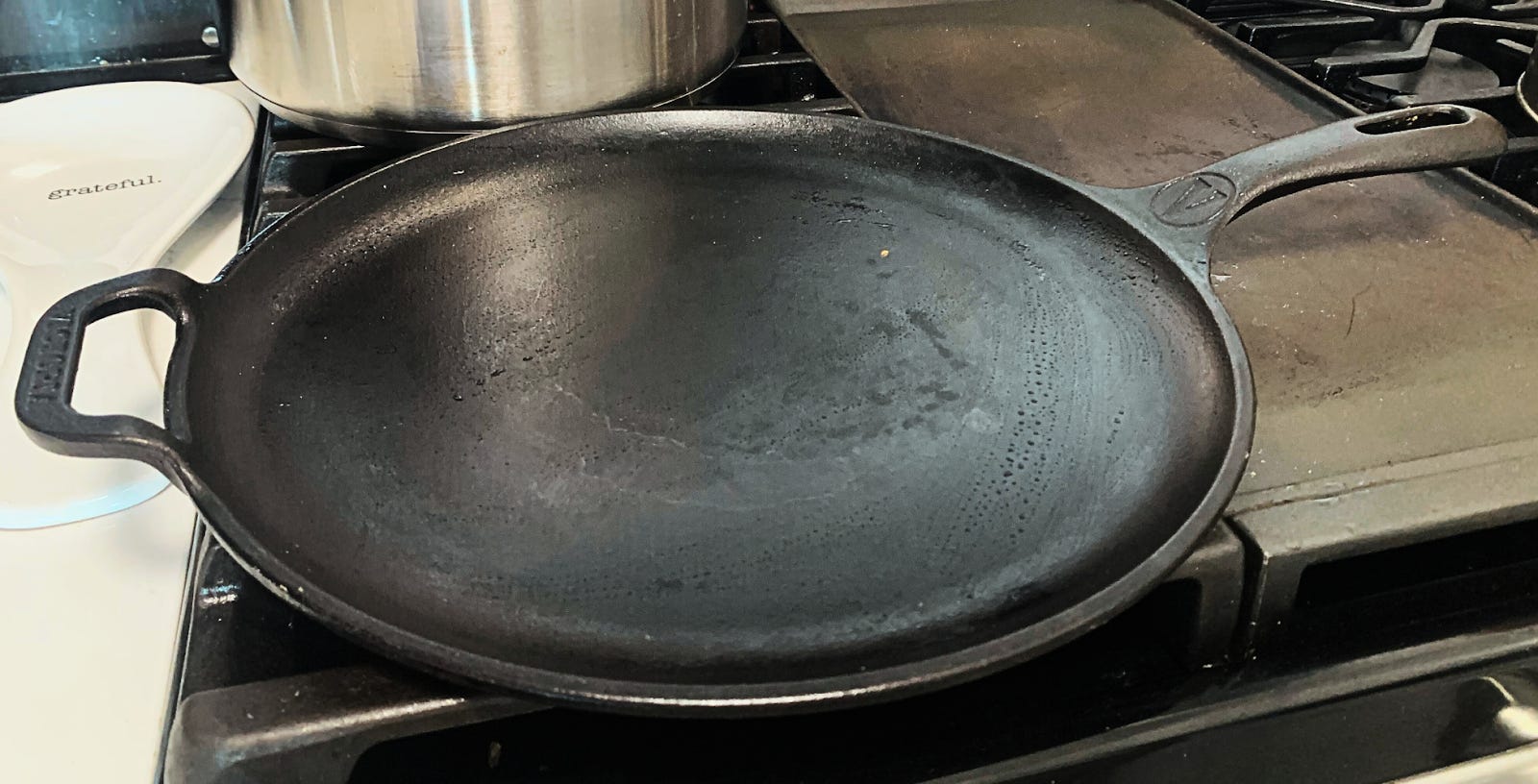
Yet, the one thing that has remained in our home, since I was born, is her flat iron griddle pan, better known among Guyanese as the Tawa. This pan makes all of our roti and paratha. We never eat a roti made in anything other than that tawa, and although family members have tried to buy her new ones to “upgrade,” she always stores them away in favor of this one.
Her tawa, to me, is the keeper of technique and the holder of every invisible inheritance—the authenticity of which could never be reflected in the pages of a cookbook. The privilege of knowing how to use that kitchen tool doesn’t just involve the ingredients, but the method: the dusting of hands, the fireproof fingers, the dance of dough across hot oil.
In the archive of the Indo-Guyanese tools, this tawa, maker of flat bread, is also a sacred artifact of survivorship, chronicling our movements and labor. Thinking about the way in which that tawa likely traveled from place to place with my mother, and the fact that she is the only one in the family that really knows how to use it, store it, respect it, and preserve it, brings me pause but also courage. I see it and I remember our family, together during a time when life’s pressures were present but kept us as a unit. It reminds me of past labor and how we would unite over a meal and talk, sometimes strained and sometimes endlessly about our hopes, our long-ago dreams, and those to come tomorrow.
What kitchen tool does your family hold as heirloom? How does it connect you to your past?